“`html
Mudjacking vs polyurethane cost comparison: real 2026 prices by slab type
⏱️ 7 min read · Last updated: 2026
- Mudjacking price per square foot: $3–$6 for standard open slabs in 2026; rises to $7–$9 on restricted-access jobs.
- Polyurethane lifting cost per square foot: $5–$25, with small patio slab jobs often landing at $10–$18 per sq ft due to minimum-charge billing.
- Average driveway slab leveling project: $800–$1,800 (mudjacking) vs. $1,200–$3,500 (polyurethane) for a two-car driveway of roughly 400–600 sq ft.
- Polyurethane foam injection costs 50–200% more than mudjacking on equivalent projects — the gap widens on small or complex slabs.
- Cure time: mudjacking slabs typically need 24–72 hours before vehicle traffic; polyurethane foam injection cures in 15–30 minutes.
Is foam leveling worth double the price? Often yes — and the reason lies under the slab, not on the invoice. The mudjacking vs polyurethane cost comparison that most contractors hand you is a single blended number. It doesn’t tell you that a 200-square-foot patio slab with limited side access can cost twice as much per square foot as a wide-open driveway slab — regardless of which method you choose.
The price gap between methods is almost never the whole story. What actually drives your bill is access difficulty, void depth, and whether a minimum charge kicks in. A $400 mudjacking quote can become a $1,100 invoice once the crew discovers the void is six inches deep and the slab borders a fence line. Without those site-specific variables on the table, any phone quote is little more than a starting point.
What follows breaks the mudjacking vs polyurethane cost comparison down the way it should be: by specific slab type, access condition, and job size — not one blended average that fits no one’s actual driveway.
How contractors actually build these quotes (most people don’t ask)
Contractors price concrete leveling on four inputs: square footage, void volume, material cost per lift, and a minimum-job charge. Most homeowners only ask about square footage — which is exactly why they’re surprised when the invoice is 40% higher than the phone quote.
For mudjacking, the material is a cement-soil slurry pumped under pressure. It’s cheap by volume — roughly $0.40–$0.80 per pound of dry mix — but it’s heavy, and crews need room to maneuver a hose and pump truck. According to Angi’s concrete leveling cost data, labor typically makes up 55–65% of a mudjacking invoice. That ratio shifts slightly for polyurethane foam injection, where the material (two-component expanding foam) costs significantly more per cubic foot but requires far less crew time and equipment staging.
Minimum charges are the hidden cost driver on small jobs. Most mudjacking contractors set a job minimum of $300–$500. Most polyurethane foam injection crews set theirs at $400–$700. On a tiny 60-square-foot patio slab, that minimum — not the square footage rate — is what you’re actually paying. This is why the per-square-foot rate on a small job looks absurdly high compared to what you’d calculate from the advertised rate. Understanding this minimum-charge dynamic is the first step toward building an accurate estimate, which the next sections will help you do by slab type.
Cost breakdown by slab type: driveway, patio, and garage floor
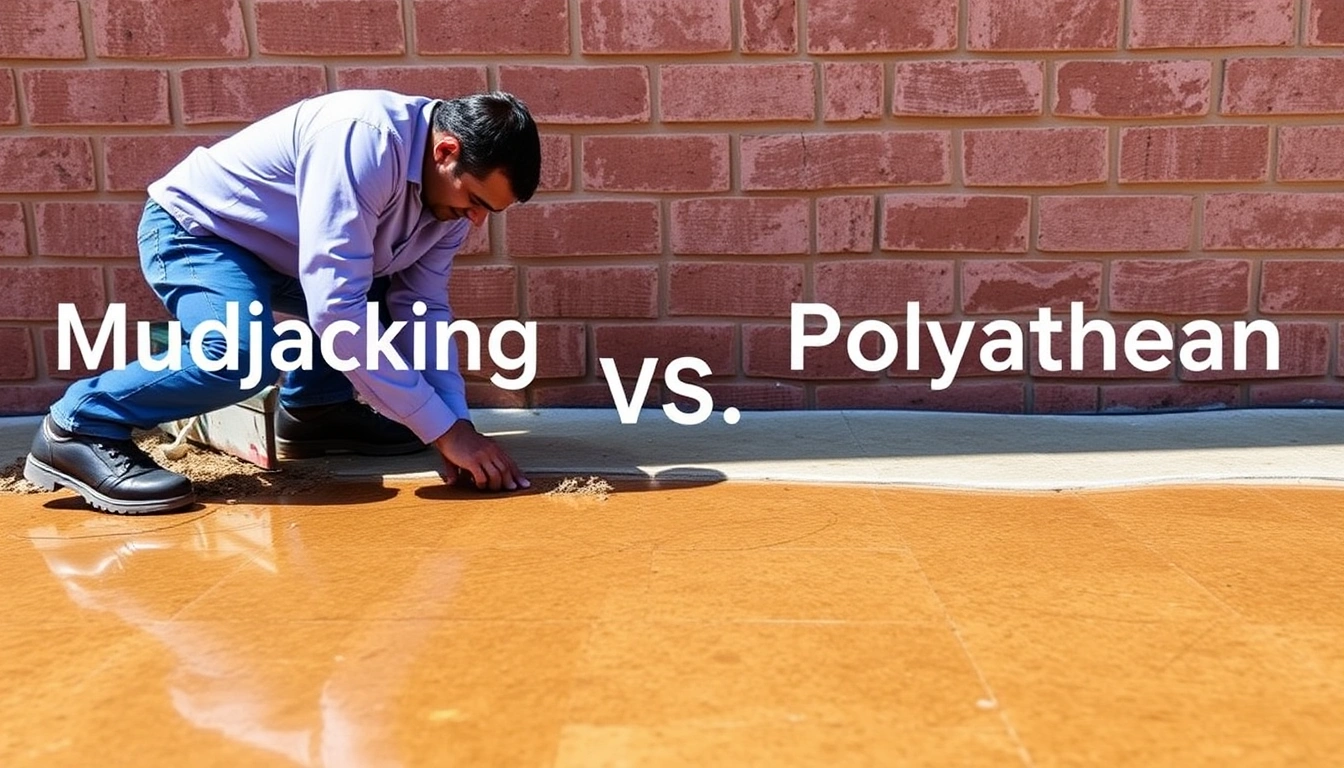
Once you understand how quotes are built, the next step is matching those inputs to your specific slab. Slab type matters more than most cost articles admit, because each surface has a different typical size, access profile, and structural load requirement. Here is how the mudjacking vs polyurethane cost comparison plays out across the three most common residential jobs in 2026.
| Slab type | Typical size | Mudjacking total | Polyurethane total | Better value pick |
|---|---|---|---|---|
| Driveway slab (two-car) | 400–600 sq ft | $800–$1,800 | $1,200–$3,500 | Mudjacking (open access) |
| Patio slab (standard) | 100–250 sq ft | $400–$900 | $600–$1,800 | Depends on access |
| Garage floor (interior) | 200–500 sq ft | $700–$2,000 | $900–$2,800 | Polyurethane (weight + fumes) |
On a large driveway slab with clean side access, mudjacking almost always wins the cost comparison — sometimes by $800 or more on a single job. That advantage shifts when you move to an enclosed space like a garage. Mudjacking inside a garage means pumping a heavy slurry mix in a confined area, dealing with 24–72 hour cure times, and adding significant weight to a slab that may already be compromised. Polyurethane foam injection’s lightweight expansion — roughly 2 lbs per cubic foot versus 100+ lbs for slurry — makes it the more practical choice for garage floors, even at a higher per-square-foot rate.
Patio slab jobs fall somewhere between these two scenarios. Access is the deciding factor, and that variable gets its own section below because it affects both methods in ways most homeowners don’t anticipate.
The access-difficulty factor that blows up your estimate
Even when you know your slab type and have a price range in mind, one site condition can erase mudjacking’s cost advantage entirely: restricted access. Access difficulty is the single biggest variable most cost comparison articles ignore — and it can add 20–60% to either method’s base price.
Mudjacking uses a large trailer-mounted pump unit. The hose is heavy and typically maxes out at around 50–75 feet in useful working length. If your slab is behind a fence, beneath a deck overhang, or adjacent to a retaining wall, that restriction forces the crew to work from an awkward angle — or decline the job entirely. Polyurethane foam injection equipment is more compact; some crews operate from a van with injection guns that can navigate tighter spaces, which is why foam often wins on restricted-access jobs even when the base rate is higher.
| Access condition | Mudjacking price impact | Polyurethane price impact | Method advantage |
|---|---|---|---|
| Open driveway, no obstructions | Base rate applies | Base rate applies | Mudjacking (lower base) |
| Patio behind fence gate (<36″ wide) | +25–40% or not feasible | +10–20% | Polyurethane |
| Under deck or overhang (<6 ft clearance) | Often declined | +15–30% | Polyurethane |
| Interior garage with narrow door | +20–35% | Base rate or +10% | Polyurethane |
The practical rule: if a standard wheelbarrow can move freely around the slab perimeter, mudjacking is viable. If it can’t, get a polyurethane foam injection quote — even if it costs more per square foot, it may be the only realistic option and could still beat a mudjacking crew’s access-premium price. With access conditions clear, you can move to the specific dollar comparisons by slab type.
How much more does polyurethane cost than mudjacking for a driveway?
On a standard two-car driveway slab with open access, polyurethane foam injection costs roughly 50–100% more than mudjacking in 2026 — translating to an additional $400–$1,700 depending on project size and void depth. The gap is real, but it narrows when you factor in cure time and long-term performance.
Here’s the specific math: a 500-square-foot driveway slab at $4.50/sq ft for mudjacking runs $2,250. The same slab at $8/sq ft for polyurethane foam injection runs $4,000. That’s a $1,750 difference. But that mudjacking job also takes the driveway out of service for 24–72 hours, while the polyurethane job is drive-ready in under an hour. If you run a home business or have multiple vehicles, that lost access time has a real cost of its own.
On a 500 sq ft driveway slab with standard access, polyurethane foam injection costs approximately $1,500–$1,750 more than mudjacking — a premium that shrinks to near-zero when access restrictions force mudjacking surcharges.
Long-term repair rates are also worth factoring into the comparison. According to the Portland Cement Association, slabs in freeze-thaw climates are especially vulnerable to sub-base erosion from water infiltration. Mudjacking slurry adds weight to the sub-base and can wash out over time, commonly leading to re-settling within 5–10 years in colder regions. Polyurethane foam injection is water-resistant and lighter, making secondary settlement less likely. For a complete driveway leveling cost guide, including when re-leveling is more economical than replacement, that resource walks through the full numbers.
That said, on large open driveways with stable soil conditions, the case for choosing polyurethane foam injection purely on cost is weak. You’re paying a meaningful premium for speed and material properties you may not need. The calculus shifts on smaller slabs, which the next section covers directly.
Is polyurethane worth the extra cost over mudjacking for a small patio?
For most small patio slabs under 150 square feet, polyurethane foam injection is worth the extra cost — not because it’s dramatically better, but because minimum charges make the actual price difference smaller than the per-square-foot rates suggest. On a 100-square-foot patio slab, you’re often paying the job minimum for either method. That minimum is $300–$500 for mudjacking and $400–$700 for polyurethane foam injection — a gap of $100–$200, not the $500+ difference the per-square-foot math implies.
The access advantage compounds this further. On small patios, restricted access is the norm, not the exception. Fences, landscaping borders, and house walls limit where a mudjacking pump hose can reach. Polyurethane foam injection crews regularly work in spaces where mudjacking isn’t physically practical. Combined with the minimal price gap at small job sizes, that access flexibility makes polyurethane the clearer call for most backyard patio slab jobs.
The one situation where mudjacking wins on a small patio: when the slab has open perimeter access on at least two sides and the void is shallow (under 1.5 inches of drop). In that scenario, the slurry material fills the void efficiently and you save $100–$300 versus foam. Outside that specific set of conditions, the extra cost for polyurethane is usually justified on small slabs. Once you’ve identified your slab type and access situation, the next step is putting those inputs into a structured estimate before you call anyone.
How to build your own driveway leveling estimate before calling a contractor
Getting a credible estimate before you call anyone gives you a number to test quotes against — and it tells you which method to ask about first. Here’s the process, step by step.
- Measure the slab area. Multiply length by width in feet to get square footage. A two-car driveway is commonly 18–24 feet wide and 18–22 feet long — roughly 400–528 sq ft. Note this number.
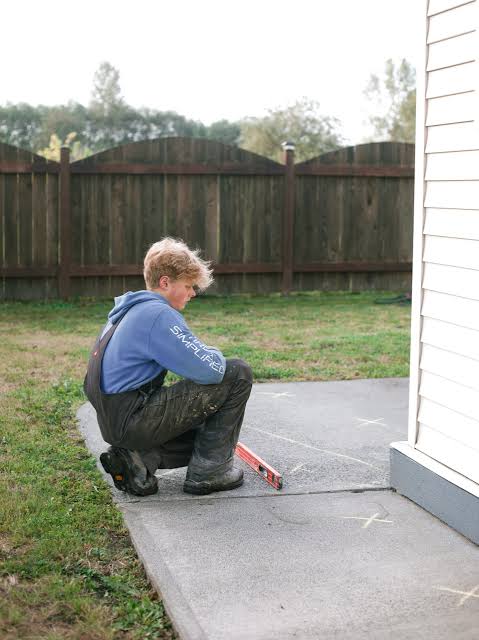
- Measure the drop. Use a 4-foot level laid across the sunken section. Measure the gap between the level and the low point of the slab. Under 1 inch: shallow void. 1–2 inches: moderate. Over 2 inches: deep void. This affects material volume and final price.
- Assess your access perimeter. Walk the entire slab edge. Can a standard pickup truck pull within 50 feet of every section? If yes, mudjacking is fully viable. If any section is blocked, mark it — that section may carry an access surcharge or require foam.
- Check the slab condition. Count visible cracks wider than 1/4 inch. Three or more significant cracks on a single panel may mean the slab is structurally compromised — in which case leveling may be a short-term fix rather than a lasting one.
- Apply the per-square-foot ranges. Multiply your square footage by $3–$6 for a mudjacking estimate and by $8–$15 for a midrange polyurethane foam injection estimate. Adjust upward by 25–40% for any access restriction you identified in step 3.
- Add the minimum-charge check. If your calculated estimate is below $400, your actual bill will likely be the contractor’s minimum — not the per-square-foot math. This is especially common on small patio slab jobs.
- Compare the two method totals. If the foam estimate is less than 60% more than the mudjacking estimate and you have any access restrictions, foam is worth serious consideration. If foam is more than double and your slab is open and accessible, mudjacking is the stronger choice.
This process takes about 20 minutes with a tape measure and a 4-foot level. It won’t replace an on-site quote, but it gives you a number to test the contractor’s estimate against. For more on how to evaluate whether leveling is even the right repair for your slab, see the concrete leveling vs replacement guide, which covers the structural thresholds where repair stops making financial sense.
The detail most homeowners get wrong when comparing quotes
With an estimate in hand, most homeowners feel ready to compare contractor quotes — but there’s one common error that distorts the comparison before it even starts. The most frequent mistake is comparing quotes that don’t cover the same scope. Mudjacking quotes often exclude crack repair, joint sealing, and cleanup. Polyurethane foam injection quotes — especially from larger operators — commonly bundle those services into the base price.
Consider two quotes side by side: $950 (mudjacking) versus $1,400 (polyurethane). The homeowner picks mudjacking. Then adds $180 for joint caulking and $95 for a crack repair kit, and realizes the polyurethane crew’s $1,400 was all-in. The real difference was $175, not $450. That gap is avoidable with one question: “What’s not included in this quote?”
Always request a line-item quote that separates lifting, crack repair, joint sealing, and cleanup — the difference between methods often shrinks to under 20% once scope is matched.
Warranty terms are equally easy to overlook but carry real monetary value. Many polyurethane foam injection contractors offer 2–5 year warranties on their work, backed by the foam manufacturer. Mudjacking warranties are shorter — commonly 1–2 years, and sometimes absent from smaller regional operators. On a $1,500 job, a 5-year warranty versus a 1-year warranty represents tangible protection against re-settling costs. For a broader look at how these methods compare beyond price — including when full replacement is the smarter call — see the concrete leveling methods compared resource.
- Mudjacking runs $3–$6/sq ft; polyurethane foam injection runs $5–$25/sq ft — the gap depends heavily on slab type and access, not just method.
- On small patio slab jobs, minimum charges make the real price difference between methods as small as $100–$200 — far less than the per-square-foot rates suggest.
- Access difficulty is the most underreported cost driver: restricted access can add 25–
See also: concrete leveling methods compared
Related: concrete leveling for garage floor settlement
Related: driveway leveling cost estimate
Related: leveling warranty terms
Related: sidewalk leveling cost
Related: sandy soil erosion

Related Posts
Concrete Leveling Process Steps: Drill, Lift, Patch Explained
Polyurethane vs mudjacking for driveway