“`html
Concrete Leveling Warranty Comparison: What’s Actually Covered
⏱️ 7 min read · Last updated: 2026
- Mudjacking warranties commonly range from 1 to 3 years; polyurethane foam warranties typically range from 5 years to lifetime, depending on the contractor.
- Soil movement exclusions appear in virtually every concrete leveling warranty — they allow contractors to deny claims when new settlement is attributed to shifting or unstable soil.
- Transferable warranties (common with polyurethane foam contractors) can add perceived value at resale, but transfer fees of $50–$150 and re-inspection requirements are standard in most contracts.
- New or adjacent settlement — slabs that sink in a different area than the original repair — is excluded from coverage in most leveling warranty terms, even on “lifetime” policies.
- The average polyurethane foam leveling job costs $3–$25 per square foot as of 2026; warranties that extend beyond 5 years are almost exclusively offered by foam contractors, not mudjacking crews.
A “lifetime warranty” on foam leveling sounds reassuring until you read page three of the contract. The soil movement exclusion buried there is what most homeowners only discover when a claim gets denied — six months after a freshly leveled slab has dropped again.
A proper concrete leveling warranty comparison isn’t about which method has the longest headline number. It’s about what the contract actually protects against, what it explicitly doesn’t, and whether that protection transfers to the next owner of your home. Warranty documents from mudjacking and polyurethane foam contractors across multiple regions show one consistent finding: the gap between the marketing and the fine print is wider than most people expect.
The good news is that once you know which four clauses to check, you can read any leveling warranty in under ten minutes and know exactly what you’re buying. Start with the basics — what a warranty actually covers — and the rest falls into place.
What does a concrete leveling warranty actually cover?
A concrete leveling warranty covers the contractor’s repair work — specifically, the labor and materials used to raise the settled slab — for a defined period, under defined conditions. It does not cover the underlying cause of settlement unless explicitly stated, and it almost never covers new settlement that begins outside the repaired area.
In practical terms, the warranty applies if the same slab drops again at the same location, within the warranty period, and the contractor determines the cause was a failure of the repair material or technique. It does not apply when the cause is soil movement, drainage changes, tree root activity, or freeze-thaw cycles — the last of which is excluded in many northern-climate contracts.
Most homeowners assume a warranty means “if it sinks again, they fix it for free.” That’s partly true. The key word is if — and the conditions that follow in the contract determine whether a real-world claim will be honored.
Coverage on paper and coverage in practice diverge most sharply when the contractor has latitude to classify new settlement as a soil movement event rather than a repair failure — and most contracts give them exactly that latitude.
The warranty period is the timeframe during which a claim can be filed. For mudjacking, this is commonly 1–3 years. For polyurethane foam injection, it commonly extends to 5–10 years, with some contractors advertising lifetime coverage. Understanding this distinction is the starting point for any honest concrete leveling warranty comparison — and it leads directly to the most important question: which method actually delivers longer protection?

Method-by-method warranty breakdown: mudjacking vs. polyurethane foam
Polyurethane foam injection consistently carries longer warranty periods than mudjacking — typically 5 to 10 years for standard residential jobs, versus 1 to 3 years for mudjacking. This difference comes down to material properties: foam is lighter, water-resistant, and doesn’t shrink or wash out the way a cement-soil slurry can over time.
| Factor | Mudjacking | Polyurethane foam injection |
|---|---|---|
| Typical warranty period | 1–3 years | 5–10 years; some lifetime |
| Soil movement exclusion | Present in most contracts | Present in most contracts |
| Transferable to new owner | Rarely | Commonly, with conditions |
| Material failure coverage | Yes (slurry washout) | Yes (foam degradation) |
| New adjacent settlement | Excluded | Excluded |
| Typical transfer fee | N/A (rarely offered) | $50–$150 + re-inspection |
The shorter mudjacking warranty reflects a material reality: the cement-soil slurry used in mudjacking can shrink as it cures and absorb moisture in areas with high groundwater. That’s not a knock on the method for every job — responsible contractors price this into their shorter warranty periods. You can explore the full mudjacking vs polyurethane cost comparison to see how warranty length factors into overall value.
Knowing which method offers longer coverage is only half the picture, though. The clause that actually determines whether a claim gets paid is buried deeper in the contract — and it applies to both methods equally.
The soil movement exclusion: the clause that voids more claims than any other
The soil movement exclusion is the single most important clause in any concrete leveling warranty — and the one most homeowners don’t notice until a claim is denied. It typically states that any new settlement caused by underlying soil movement, erosion, or instability is not covered, regardless of how much warranty time remains.
Here’s why this matters: most slab settlement is caused by soil movement. Voids form under concrete because soil erodes, compresses, or shifts due to water drainage, tree roots, freeze-thaw cycling, or poor original compaction. When that process continues after a leveling job, the contractor can classify the new settlement as a soil event rather than a repair failure.
The distinction between “the repair failed” and “the soil moved again” is genuinely ambiguous in many cases — and in most warranty contracts, the contractor makes that call. That’s not inherently dishonest; it reflects a real limitation of any leveling method. But it does mean a 10-year foam warranty with a broad soil movement exclusion may offer less real-world protection than a 3-year mudjacking warranty from a contractor with a more narrowly written exclusion clause.
The soil movement exclusion appears in virtually every concrete leveling contract regardless of method — making the headline warranty period a less reliable indicator of coverage than the specific language of the exclusion itself.
What to look for instead: a warranty that specifies a maximum re-settlement measurement — for example, more than 3/4 inch of re-drop within the warranty period triggers a free repair — is more useful than one that uses open-ended language about soil conditions. Some foam contractors offering premium-tier leveling warranty terms have begun adding this kind of measurable threshold. It’s worth asking for. Once you understand the exclusion clause, the next logical question is whether a longer foam warranty actually beats a shorter mudjacking one in practice.
Is a lifetime foam warranty better than a mudjacking warranty?
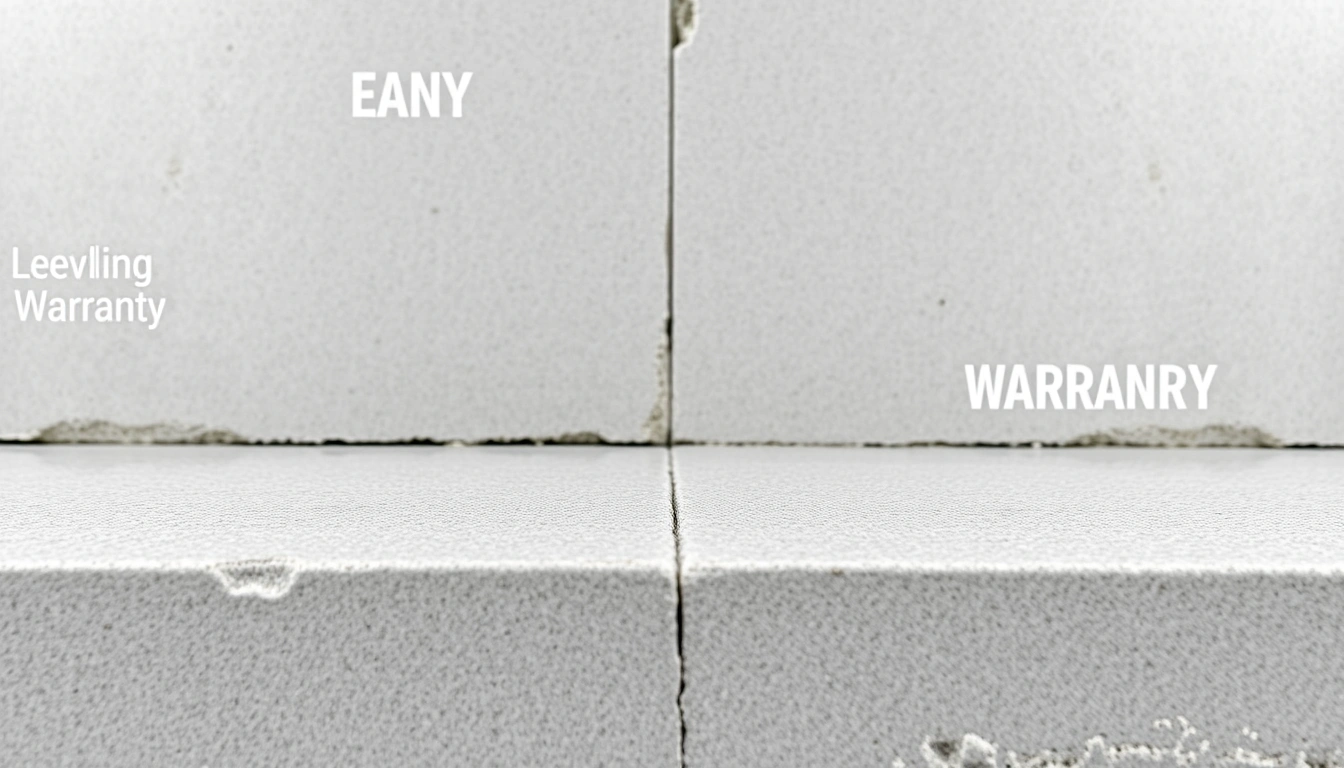
A lifetime foam warranty looks better on paper — but in practice, the soil movement exclusion and the contract’s definition of “lifetime” often narrow that advantage considerably. The honest answer depends on three things: the breadth of the exclusion clauses, the financial stability of the contractor, and the specific conditions of your site.
“Lifetime” in leveling warranty terms typically means the lifetime of the original homeowner, or sometimes the life of the structure — not a perpetual obligation to repair regardless of cause. Some contractors use “lifetime” to mean 25 years. Others mean it literally. The contract text is the only reliable source.
Polyurethane foam injection does have a genuine durability advantage over mudjacking material. Closed-cell foam resists water, doesn’t biodegrade in most soil conditions, and adds minimal load to the subbase — all of which reduce the probability of re-settlement from material failure. That’s a real difference, and it supports the longer warranty periods foam contractors offer.
| Warranty scenario | Practical protection level | Best suited for |
|---|---|---|
| Mudjacking, 1–2 year warranty | Low–moderate (broad exclusions common) | Stable soil, budget-focused jobs |
| Foam, 5-year limited warranty | Moderate (clearer terms, still excludes soil) | Most residential driveways and walkways |
| Foam, 10-year limited warranty | Moderate–high (if exclusions are narrow) | Pool decks, commercial entries, garage slabs |
| Lifetime foam warranty (broad exclusions) | Low–moderate (headline misleads) | Stable sites only; verify contractor longevity |
| Lifetime foam warranty (narrow exclusions, measurable thresholds) | High | Long-term homeowners planning to stay 10+ years |
There’s also a contractor-longevity issue that rarely comes up in these comparisons. A concrete leveling warranty is only as durable as the company backing it. A regional mudjacking contractor with 25 years of local history may be a safer warranty bet than a franchise foam operation with three years in the market, regardless of the headline term. Before committing, review the full breakdown of concrete leveling methods compared to understand how each method performs over time.
With the method comparison settled, the next factor that changes how much a warranty is actually worth is whether it can transfer to a new owner — which matters more than most homeowners realize at signing.
Transferable warranties: what they’re worth and when they actually matter
A transferable warranty lets coverage pass to the next homeowner if the property sells during the warranty period. Foam contractors offer this far more often than mudjacking crews. For a homeowner planning to sell within the warranty period, this is a meaningful selling point. For someone staying put for 20 years, it’s largely irrelevant.
The transfer process is not automatic. Most contracts require the new homeowner to notify the contractor within 30–90 days of closing, pay a transfer fee of $50–$150, and in many cases schedule a re-inspection before coverage activates for the new owner. Contracts that skip the re-inspection step are rare and worth noting — they represent a genuinely stronger transferable warranty.
From a real estate perspective, a transferable leveling warranty is a disclosure asset. It tells the buyer that the settlement was professionally addressed and that coverage remains in place. Whether the buyer assigns significant value to it depends on how they read the exclusion clauses — which most buyers never do. Don’t assume a transferable warranty will lift your sale price materially; it’s more useful as a negotiation buffer than a value driver.
One detail that almost no comparison article covers: some contractors void the transferable warranty if any subsequent concrete work — patching, sealing, or resurfacing — is performed by a third party after the leveling job. If you plan to patch cracks or seal the driveway yourself, confirm this won’t nullify your coverage. For garage-specific jobs, the considerations differ slightly — concrete leveling for garage floor settlement involves different drainage and load factors that affect long-term warranty validity. Understanding what to look for in these contracts leads directly to how you should verify any warranty before you hire.
How to read and verify a leveling warranty before you sign anything
Verifying a concrete leveling warranty before hiring comes down to six steps — each targeting a clause type that commonly causes claim denials. Most warranty documents are one to two pages, and you’re looking for specific language rather than reading every word, so this goes faster than it sounds.
- Request the warranty document before the quote appointment. Any contractor who won’t provide it in writing before you sign is a red flag. The warranty should be a standalone document, separate from the service agreement.
- Find the exclusion section. It may be titled “Limitations,” “Exclusions,” or “What is not covered.” Read every line. Note the soil movement exclusion language specifically — is it broad (“any soil movement”) or narrow (“soil movement exceeding X inches in Y timeframe”)? The narrower, the better for the homeowner.
- Check for a settlement threshold. A strong warranty specifies a measurable re-settlement amount that triggers a free repair — typically expressed in fractions of an inch. No threshold means the contractor decides whether the re-drop is significant enough to address.
- Confirm the transferability terms. Look for the transfer fee amount, the notification window after closing, whether re-inspection is required, and any third-party-work voiding clauses. If transferability isn’t mentioned, it likely doesn’t exist.
- Check what “lifetime” means in the contract. Look for language defining the term — homeowner’s ownership period, a fixed number of years, or the life of the structure. If it’s undefined, ask in writing and get the answer added to the document.
- Verify the contractor’s business standing. A warranty is only as good as the company backing it. Check for state licensing, Better Business Bureau standing, and years in business. A five-year-old company offering a lifetime warranty is a different proposition than a 20-year regional firm doing the same.
The concrete leveling cost guide covers what to expect to pay across methods and regions — useful context when evaluating whether a higher price for better warranty terms is justified. For projects involving significant pooling water near the slab, also review concrete leveling and drainage issues, since drainage problems affect both long-term settlement risk and warranty validity.
Key takeaways
- Mudjacking warranties run 1–3 years; polyurethane foam warranties commonly run 5–10 years or lifetime — but the soil movement exclusion limits real-world coverage in both cases.
- A lifetime foam warranty with broad exclusions can offer less practical protection than a shorter mudjacking warranty that includes a measurable settlement threshold.
- Transferable warranties matter most for homeowners selling within the warranty period — they’re rarely worth paying a significant premium for if you plan to stay long-term.
- Reading the exclusion section and verifying the contractor’s business standing are the two steps that prevent the most claim denials.
Common questions about concrete leveling warranty comparison
What is typically covered by a concrete leveling warranty?
Most concrete leveling warranties cover re-settlement of the same repaired area due to material failure — meaning the mudjacking slurry eroded or the foam degraded. When that happens, the contractor returns to re-level the slab at no charge for labor or materials. They do not typically cover new settlement in adjacent areas, drainage-related movement, or freeze-thaw damage.
How do I verify a concrete leveling warranty before hiring a contractor?
Request the warranty document in writing before signing anything. Look specifically for the exclusion section, whether a measurable re-settlement threshold is defined, and what “lifetime” means if that term is used. Confirm transferability terms, any third-party-work voiding clauses, and check the contractor’s licensing and years in business.
Lifetime foam vs limited mudjacking warranty — which is actually better?
A lifetime foam warranty is better when the exclusion clauses are narrow and the contractor has a long business history. A limited mudjacking warranty with a specific re-settlement threshold — for example, a 3/4-inch re-drop triggers a free repair — can outperform a broad lifetime foam warranty in real claims situations. Read the exclusions, not just the headline term.
Why did my concrete leveling warranty claim get denied after the slab re-settled?
The most common reason for denial is the soil movement exclusion. If the contractor determines that re-settlement was caused by shifting or eroding soil rather than a failure of the repair material, most contracts allow them to deny the claim — regardless of how much time remains in the warranty period.
How much value does a longer concrete leveling warranty add to a repair job?
A longer warranty adds real value when it includes a measurable settlement threshold and narrow exclusions. It adds minimal value when it’s headline-only, backed by broad soil movement exclusions. For homeowners selling within 5 years, a transferable foam warranty has the most tangible benefit — it supports disclosure documentation at closing.
Can I transfer a concrete leveling warranty when I sell my house?
Transferable warranties are available mainly through polyurethane foam contractors. The process typically requires notifying the contractor within 30–90 days of closing, paying a transfer fee of $50–$150, and scheduling a re-inspection. Mudjacking contractors rarely offer transferable coverage. Always
See also: concrete leveling methods compared
See also: concrete leveling for garage floor settlement
See also: mudjacking vs polyurethane cost comparison
Related: sidewalk leveling cost
Related: concrete leveling for sandy soil
Related: pool deck leveling


Related Posts
Concrete Leveling Process Steps: Drill, Lift, Patch Explained
Polyurethane vs mudjacking for driveway